

The $100B Weight-Loss Drug Boom Has a Blind Spot — Are You Positioned for It?
Muscle Loss, Regain After Discontinuation, and GI Side Effects Are Driving Demand for Complementary Nutritional Solutions
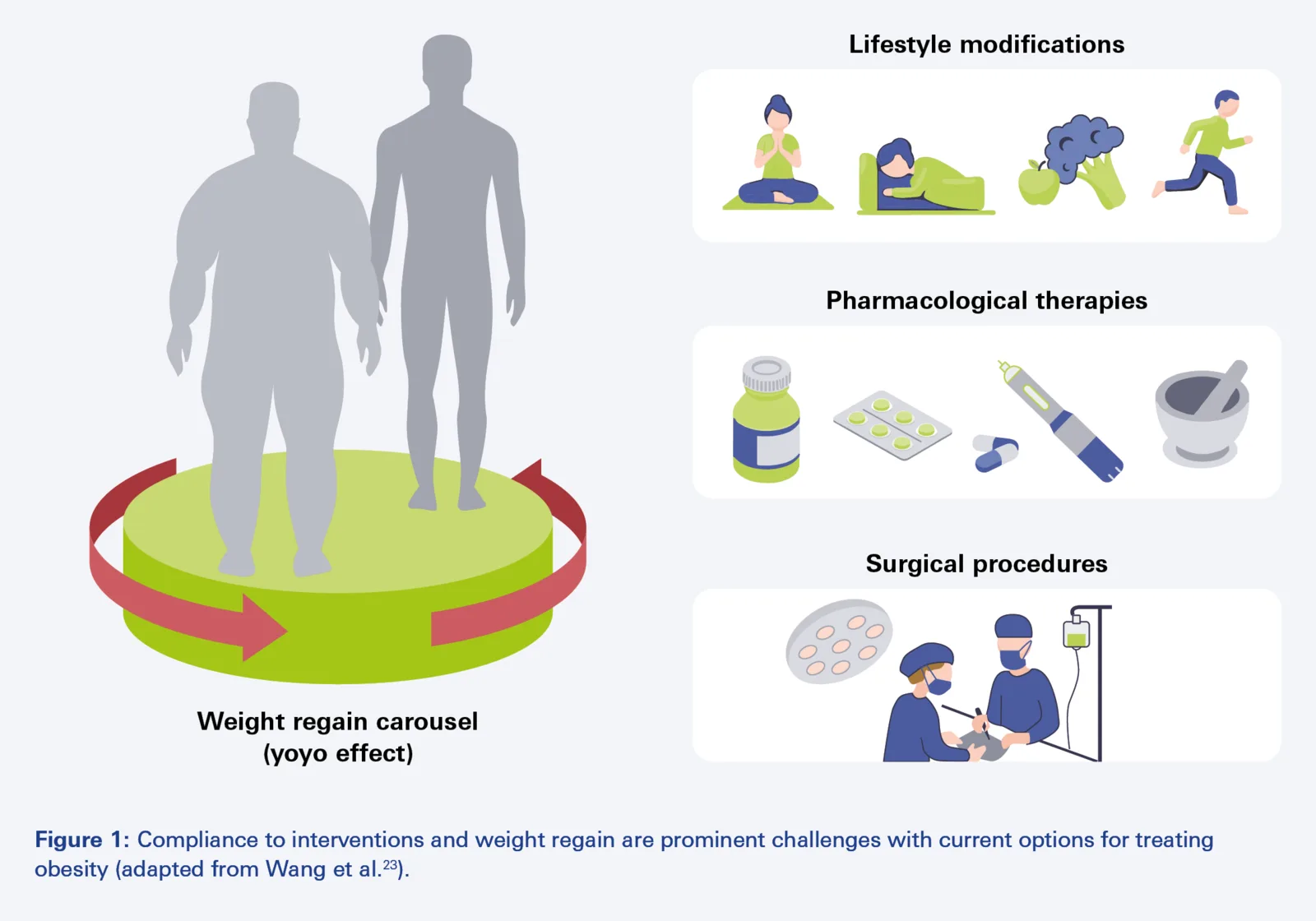
The management of overweight and obesity represents one of the most complex and challenging areas in modern healthcare. The current therapeutic landscape encompasses three primary pillars: lifestyle interventions, pharmacotherapy, and surgical procedures, each offering distinct benefits but presenting unique challenges for patients.8
Lifestyle modifications, including dietary changes and increased physical activity, remain the cornerstone of obesity management but prove exceptionally difficult for patients to maintain long-term.9 Most patients struggle to sustain dietary restrictions and exercise regimens necessary for meaningful weight loss beyond 12-18 months.10 The psychological and social barriers to permanent lifestyle change, combined with environmental factors that promote weight gain, create substantial obstacles even for highly motivated patients.11
Pharmacological interventions, particularly glucagon-like peptide-1 receptor agonists like semaglutide and liraglutide, have emerged as promising options for individuals with type 2 diabetes and/or obesity (BMI over 30), demonstrating substantial weight loss of 10-15% in clinical trials.12,13 However, patients often face challenges accessing these medications and frequently experience troublesome gastrointestinal side effects including nausea, constipation, abdominal pain, and vomiting, which often lead to treatment discontinuation.14,15 Recent research findings indicate that adverse events not only affect the gastro-intestinal tract but involve pathological changes across multiple systems (cardiovascular, neurological, reproductive, immune and respiratory) and organs (liver, kidneys, thyroid and retina).16 Additionally, patients seem to rapidly regain a significant amount of weight after the discontinuation of these medications17 and some overweight users also report the unwanted loss of skeletal muscle mass during the intervention.
Surgical procedures such as bariatric surgery remains the most effective long-term weight loss treatment, typically resulting in durable 25% weight loss and rapid improvement in obesity-related complications for the majority of patients.18 Nevertheless, up to 40% of bariatric surgery patients experience significant weight regain within several years.19,20 Furthermore, access remains limited primarily to patients with severe obesity, and procedures carry inherent surgical risks including anastomotic leaks, bleeding, strictures, and nutritional deficiencies requiring lifelong monitoring.21,22
Taken together, the pervasive problem of weight regain following treatment cessation or reduced adherence is a challenge across all treatment modalities and frequently coincides with the return of obesity-related comorbidities and psychological distress. This highlights the chronic nature of obesity and the need for long-term, multimodal treatment approaches.

Sources
- Perdomo, C.M., Cohen, R.V., Sumithran, P., Clément, K., and Frühbeck, G. (2023). Contemporary medical, device, and surgical therapies for obesity in adults. Lancet 401, 1116-1130. 10.1016/s0140-6736(22)02403-5.
- Oppert, J.M., Ciangura, C., and Bellicha, A. (2023). Physical activity and exercise for weight loss and maintenance in people living with obesity. Rev Endocr Metab Disord 24, 937-949. 10.1007/s11154-023-09805-5.
- Greenway, F.L. (2015). Physiological adaptations to weight loss and factors favouring weight regain. Int J Obes (Lond) 39, 1188-1196. 10.1038/ijo.2015.59.
- Petroni, M.L., Caletti, M.T., Calugi, S., Dalle Grave, R., and Marchesini, G. (2017). Long-term treatment of severe obesity: are lifestyle interventions still an option? Expert Rev Endocrinol Metab 12, 391-400. 10.1080/17446651.2017.1386551.
- Ard, J., Fitch, A., Fruh, S., and Herman, L. (2021). Weight Loss and Maintenance Related to the Mechanism of Action of Glucagon-Like Peptide 1 Receptor Agonists. Adv Ther 38, 2821-2839. 10.1007/s12325-021-01710-0.
- Esparham, A., Mehri, A., Dalili, A., Richards, J., and Khorgami, Z. (2024). Safety and efficacy of glucagon-like peptide-1 (GLP-1) receptor agonists in patients with weight regain or insufficient weight loss after metabolic bariatric surgery: A systematic review and meta-analysis. Obes Rev 25, e13811. 10.1111/obr.13811.
- Wharton, S., Kuk, J.L., Luszczynski, M., Kamran, E., and Christensen, R.A.G. (2019). Liraglutide 3.0 mg for the management of insufficient weight loss or excessive weight regain post-bariatric surgery. Clin Obes 9, e12323. 10.1111/cob.12323.
- Lexchin, J., and Mintzes, B. (2023). Semaglutide: a new drug for the treatment of obesity. Drug Ther Bull 61, 182-188. 10.1136/dtb.2023.000007.
- He, X., Zhao, Z., Sun, Y., and Jiang, X. (2025). Unraveling the safety profile of GLP-1 receptor agonists: Mechanistic insights with a focus on semaglutide. Eur J Med Chem 300, 118163. 10.1016/j.ejmech.2025.118163.
- Wu, H., Yang, W., Guo, T., Cai, X., and Ji, L. (2025). Trajectory of the body weight after drug discontinuation in the treatment of anti-obesity medications. BMC Med 23, 398. 10.1186/s12916-025-04200-0.
- Müller, T.D., Blüher, M., Tschöp, M.H., and DiMarchi, R.D. (2022). Anti-obesity drug discovery: advances and challenges. Nat Rev Drug Discov 21, 201-223. 10.1038/s41573-021-00337-8.
- Istfan, N.W., Lipartia, M., Anderson, W.A., Hess, D.T., and Apovian, C.M. (2021). Approach to the Patient: Management of the Post-Bariatric Surgery Patient With Weight Regain. J Clin Endocrinol Metab 106, 251-263. 10.1210/clinem/dgaa702.
- Velapati, S.R., Shah, M., Kuchkuntla, A.R., Abu-Dayyeh, B., Grothe, K., Hurt, R.T., and Mundi, M.S. (2018). Weight Regain After Bariatric Surgery: Prevalence, Etiology, and Treatment. Curr Nutr Rep 7, 329-334. 10.1007/s13668-018-0243-0.
- Felsenreich, D.M., Bichler, C., Langer, F.B., Gachabayov, M., and Prager, G. (2020). Sleeve Gastrectomy: Surgical Technique, Outcomes, and Complications. Surg Technol Int 36, 63-69.
- Blüher, M., Aras, M., Aronne, L.J., Batterham, R.L., Giorgino, F., Ji, L., Pietiläinen, K.H., Schnell, O., Tonchevska, E., and Wilding, J.P.H. (2023). New insights into the treatment of obesity. Diabetes Obes Metab 25, 2058-2072. 10.1111/dom.15077.