
A Probiotic That Absorbs Fat Before You Do
Screened from Over 20,000 Bacterial Strains, JBD Probiotics Intercept Dietary Fat Absorption at the Source
The JBD probiotic family represents an innovative approach to weight management, comprising three specific Lactobacillus strains (Lactobacillus reuteri JBD301, Lactobacillus plantarum JBD302, Lactobacillus paracasei JBD305) identified through rigorous screening of over 20,000 bacterial strains from the gut of healthy lean adults for their superior efficacy in fatty acid absorption.
The weight management mechanism of the JBD strains thus relies on their capacity to intercept dietary fat absorption. Under normal physiological conditions, dietary fats are hydrolyzed through a process known as lipolysis, releasing free fatty acids (FFA) for absorption by intestinal epithelial cells and subsequent transport to tissues for energy metabolism and storage (Fig 3a). The JBD probiotic strains disrupt this process by competitively absorbing FFA in the intestinal lumen, effectively reducing the quantity of fatty acids available for host uptake (Fig 3b). These bacteria-incorporated fatty acids are subsequently eliminated through fecal matter.
This innovative mechanism offers a unique, microbiome-based approach that complements conventional weight management strategies, including dietary modifications, lifestyle interventions, and pharmacological treatments.
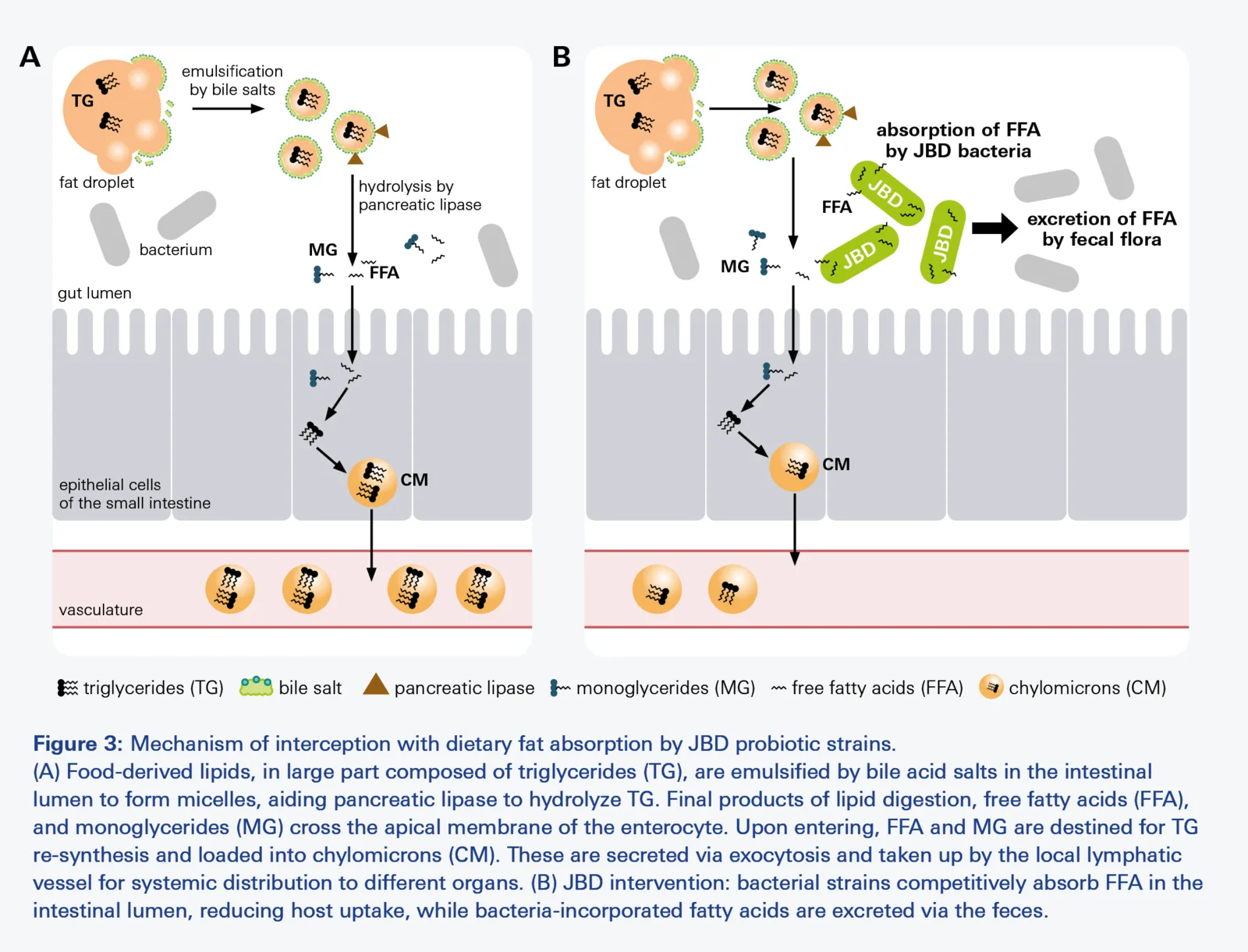
(A) Food‐derived lipids, in large part composed of triglycerides (TG), are emulsified by bile acid salts in the intestinal lumen to form micelles, aiding pancreatic lipase to hydrolyze TG. Final products of lipids digestion, free fatty acids (FFA), and monoglycerides (MG) cross the apical membrane of the enterocyte. Upon entering, FFAs and MG are destined for TG re‐synthesis and loaded into chylomicrons (CM). These are secreted via exocytosis and taken up by the local lymphatic vessel for systemic distribution to different organs. (B) JBD intervention: bacterial strains competitively absorb FFA in the intestinal lumen, reducing host uptake, while bacteria-incorporated fatty acids are excreted via the feces.