

A Probiotic That Performs Like an FDA-Approved Weight-Loss Drug — Without the Side Effects
In Head-to-Head Testing, JBD301 Matched Orlistat's Weight-Stabilizing Effect While Also Reducing Visceral Fat and Improving Cholesterol
Clinical trials demonstrate that specific probiotic strains, from the genus Lactobacillus, can significantly reduce weight or waist circumference and achieve metabolic improvements in overweight and obese individuals by restoring beneficial bacterial populations, enhancing intestinal barrier function, or modulating inflammatory pathways.41-43
A growing body of clinical evidence indicates safe use and beneficial impact of the species Lactobacillus plantarum*, Lactobacillus reuteri and *Lactobacillus paracasei on overweight individuals.
- A recent meta-analysis reviewing 9 randomized controlled trials (RCTs) focusing on the effects of L. plantarum supplementation in overweight adults found a significant weight reduction and BMI decrease with this species compared to placebo and observed improvements in some inflammatory markers.44 In additional trials, L. plantarum strains significantly reduced body fat percentage, body fat mass, and subcutaneous fat area,45 or significantly improved gastrointestinal health in overweight participants.46
- First clinical trials with L. paracasei demonstrate promising therapeutic potential for this species for individuals with obesity and being affected by the metabolic syndrome: The intake of L. paracasei resulted in delayed weight gain, a significantly improved blood parameters such as reduced cholesterol and triglyceride levels, and improved endothelial function.47
- Initial clinical investigations with L. reuteri indicate encouraging therapeutic effects with consistent anti-inflammatory effects and metabolic improvements, as well as BMI reduction in some studies.40,48-50
Some of the great advantages of using probiotic bacteria in weight management are:
- The easy compliance to the treatment – especially in comparison to lifestyle changes.
- The lack of unpleasant or dangerous side effects – especially in comparison to pharmacological treatment options.
Randomized placebo-controlled clinical trial40
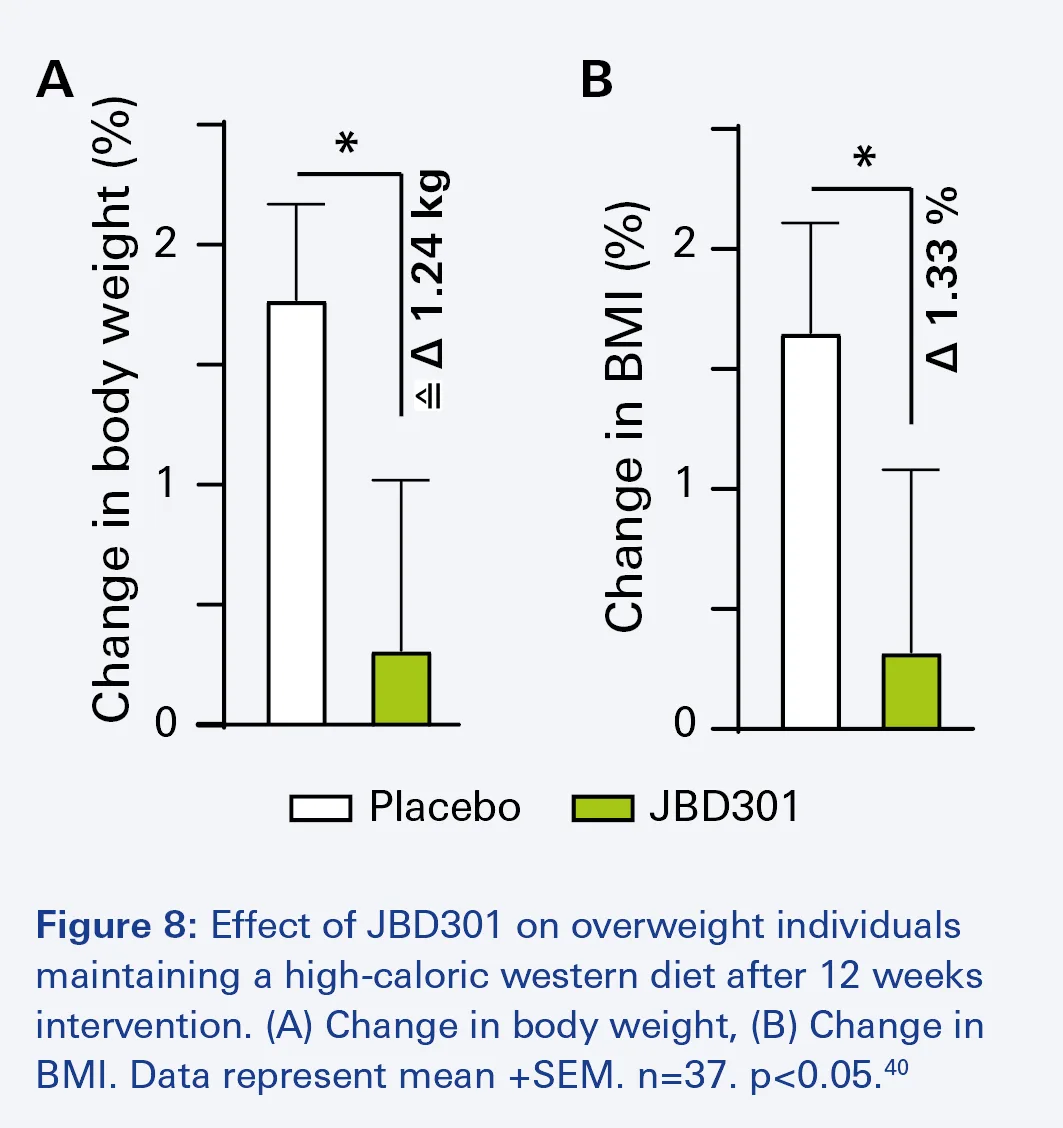
To translate preclinical findings into human evidence, a randomized, placebo-controlled clinical trial was conducted to evaluate the weight management efficacy of L. reuteri JBD301 in overweight individuals on a high-caloric diet:
The trial enrolled 37 Asian adults (male and female) consuming a habitual Western diet (diet high in fat, sugar and salt), with baseline BMI ranging from 25 to 35 kg/m² and a mean age of 40 years. Participants were randomly assigned to receive either daily oral supplementation with 1×10⁹ viable, colony-forming units of L. reuteri JBD301 or matching placebo for 12 weeks. Critically, no dietary restrictions or exercise interventions were imposed, allowing assessment of probiotic efficacy under real-world conditions without lifestyle modification confounders.
After 12 weeks, JBD301-supplemented participants maintained stable body weight, whereas the placebo group experienced significant weight gain (+1.43 kg), resulting in a statistically significant between-group difference of 1.24 kg (Fig. 8A). Correspondingly, BMI remained stable in the JBD301 group while it increased by 1.65% in placebo-treated subjects, yielding a significant difference of 1.33% between groups (Fig. 8B). Additionally, participants taking JBD301 did not increase their body fat mass during the intervention period (-0.38%) in contrast to placebo controls (+3.41%; between group difference for change in body fat mass p=0.053).
These findings provide the first human evidence that L. reuteri JBD301 supplementation can prevent weight gain in overweight individuals maintaining a high-caloric Western diet without concurrent lifestyle interventions. The magnitude and direction of effects observed in this trial are consistent with the preclinical murine data, supporting the translational validity of the proposed fatty acid sequestration mechanism.

Sources
- Chung, H.J., Yu, J.G., Lee, I.A., Liu, M.J., Shen, Y.F., Sharma, S.P., Jamal, M.A., Yoo, J.H., Kim, H.J., and Hong, S.T. (2016). Intestinal removal of free fatty acids from hosts by Lactobacilli for the treatment of obesity. FEBS Open Bio 6, 64-76. 10.1002/2211-5463.12024.
- Álvarez-Arraño, V., and Martín-Peláez, S. (2021). Effects of Probiotics and Synbiotics on Weight Loss in Subjects with Overweight or Obesity: A Systematic Review. Nutrients 13. 10.3390/nu13103627.
- Tomé-Castro, X.M., Rodriguez-Arrastia, M., Cardona, D., Rueda-Ruzafa, L., Molina-Torres, G., and Roman, P. (2021). Probiotics as a therapeutic strategy in obesity and overweight: a systematic review. Benef Microbes 12, 5-15. 10.3920/bm2020.0111.
- Brusaferro, A., Cozzali, R., Orabona, C., Biscarini, A., Farinelli, E., Cavalli, E., Grohmann, U., Principi, N., and Esposito, S. (2018). Is It Time to Use Probiotics to Prevent or Treat Obesity? Nutrients 10. 10.3390/nu10111613.
- Li, C.-P., Chen, C.-C., Hsiao, Y., Kao, C.-H., Chen, C.-C., Yang, H.-J., and Tsai, R.-Y. (2024). The Role of Lactobacillus plantarum in Reducing Obesity and Inflammation: A Meta-Analysis. International Journal of Molecular Sciences 25, 7608.
- Shin, S.M., Park, J.S., Kim, S.B., Cho, Y.H., Seo, H., and Lee, H.S. (2024). A 12-Week, Single-Centre, Randomised, Double-Blind, Placebo-Controlled, Parallel-Design Clinical Trial for the Evaluation of the Efficacy and Safety of Lactiplantibacillus plantarum SKO-001 in Reducing Body Fat. Nutrients 16. 10.3390/nu16081137.
- Tsai, Y.S., Lin, X.B., Lin, S.W., Chen, Y.L., Hsu, C.L., and Chen, C.C. (2025). Impact of probiotic Lactobacillus plantarum GKM3 on gastrointestinal health in overweight and obese individuals: A randomized clinical trial. Clin Nutr ESPEN 68, 283-291. 10.1016/j.clnesp.2025.05.026.
- Yang, J., Huang, J., Huang, Z., Xu, Y., Li, W., Zhu, S., Zhao, Y., Ye, B., Liu, L., Zhu, J., et al. (2023). Cardiometabolic benefits of Lacticaseibacillus paracasei 8700:2: A randomized double-blind placebo-controlled trial. Clin Nutr 42, 1637-1646. 10.1016/j.clnu.2023.07.017.
- Tenorio-Jiménez, C., Martínez-Ramírez, M.J., Del Castillo-Codes, I., Arraiza-Irigoyen, C., Tercero-Lozano, M., Camacho, J., Chueca, N., García, F., Olza, J., Plaza-Díaz, J., et al. (2019). Lactobacillus reuteri V3401 Reduces Inflammatory Biomarkers and Modifies the Gastrointestinal Microbiome in Adults with Metabolic Syndrome: The PROSIR Study. Nutrients 11. 10.3390/nu11081761.
- Kong, X.J., Liu, K., Zhuang, P., Tian, R., Liu, S., Clairmont, C., Lin, X., Sherman, H., Zhu, J., Wang, Y., et al. (2021). The Effects of Limosilactobacillus reuteri LR-99 Supplementation on Body Mass Index, Social Communication, Fine Motor Function, and Gut Microbiome Composition in Individuals with Prader-Willi Syndrome: a Randomized Double-Blinded Placebo-Controlled Trial. Probiotics Antimicrob Proteins 13, 1508-1520. 10.1007/s12602-021-09800-9.
- Simon, M.C., Strassburger, K., Nowotny, B., Kolb, H., Nowotny, P., Burkart, V., Zivehe, F., Hwang, J.H., Stehle, P., Pacini, G., et al. (2015). Intake of Lactobacillus reuteri improves incretin and insulin secretion in glucose-tolerant humans: a proof of concept. Diabetes Care 38, 1827-1834. 10.2337/dc14-2690.