

Beyond GLP-1s and Surgery: The Case for Targeting the Gut Microbiome
Emerging Research Reveals How Dysbiosis Drives Obesity — and Why Probiotic Intervention Could Be the Missing Link
The gut microbiome has emerged as a fundamental regulator of host energy metabolism and weight homeostasis, with mounting evidence demonstrating that microbial dysbiosis plays a causative role in obesity development and maintenance.
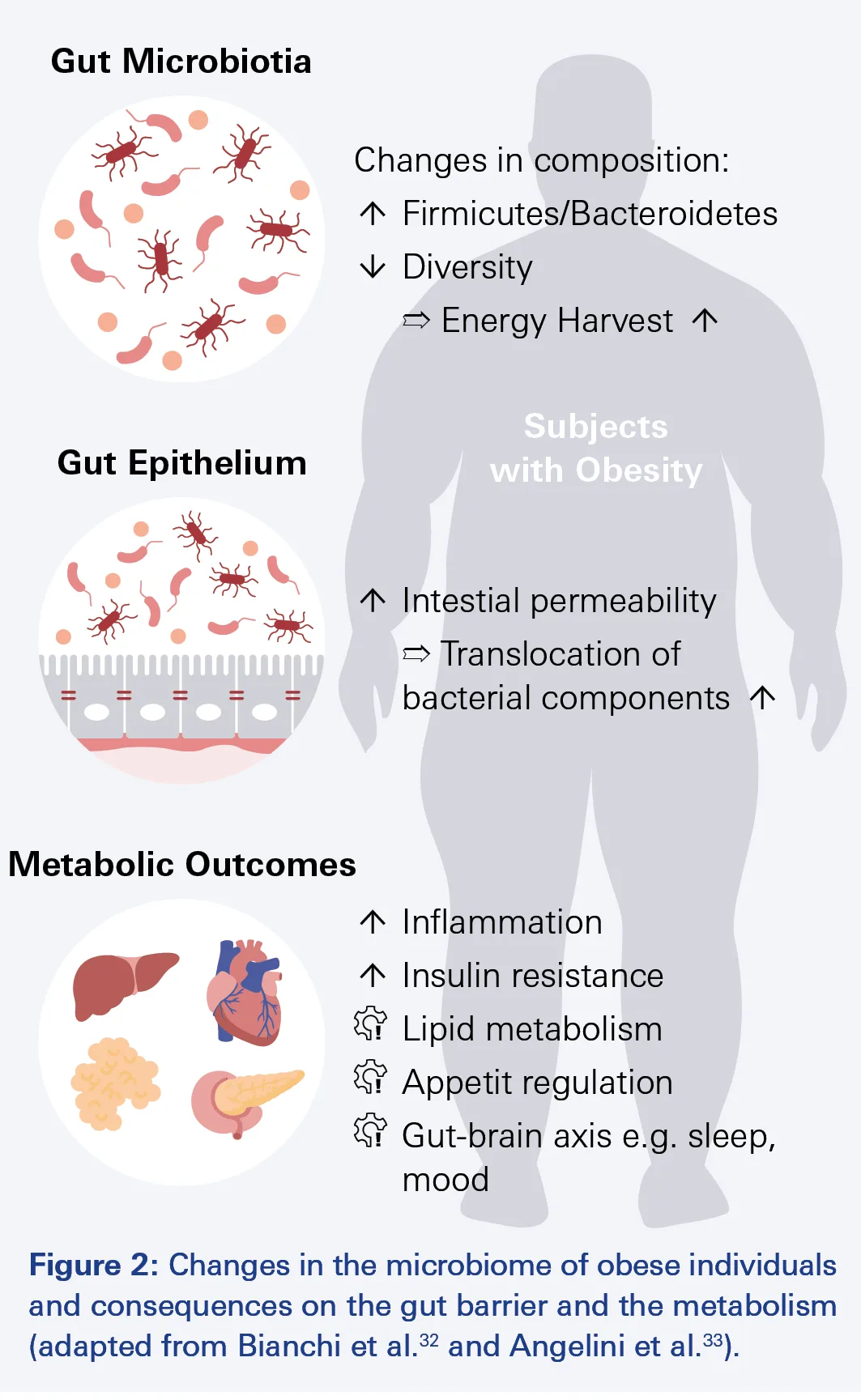
Obese individuals consistently exhibit altered microbial compositions characterized by reduced overall microbial diversity, an increased Firmicutes to Bacteroidetes ratio and decreased abundance of beneficial species.24
These compositional changes profoundly impact host metabolism, the breakdown and conversion of food components, as well as immune reactions:
- The altered microbiome enhances energy harvest from dietary components, with certain bacteria possessing greater capacity for energy extraction from consumed food.25,26 Current findings suggest that energy-rich food further promotes these types of bacteria.27
- The dysbiotic microbiomes promotes metabolic dysfunction through disruption of intestinal barrier integrity, leading to increased permeability and subsequent translocation of undesired bacterial components such as LPS into systemic circulation.28 There, they trigger chronic low-grade inflammation, promoting insulin resistance, adipose tissue inflammation, and altered lipid metabolism.29
- The microbiome directly influences appetite regulation and energy homeostasis through modulation of gut hormone production, including appetite regulating hormones such as glucagon-like peptide-1 (GLP-1), peptide YY, and ghrelin, while also affecting the endocannabinoid system and bile acid metabolism.30 Moreover, specific bacterial metabolites can serve as signaling molecules regulating glucose homeostasis, lipogenesis, and appetite through activation of receptors and modulation of gene expression in metabolically active tissues.31 This can cause a disturbed lipid metabolism and enhanced insulin resistance in the case of a dysbiotic obese microbiome.
- The altered microbiome can lead to disturbed microbial neurotransmitter production that can negatively impact the gut-brain axis leading to altered circadian rhythms and sleep patterns. This creates additional metabolic perturbations contributing to weight gain.32
Given these profound microbial influences on obesity, probiotic interventions represent a promising therapeutic strategy for weight management by targeting the underlying microbial imbalances that contribute to weight gain and metabolic dysfunction.
The mechanisms mediating the beneficial effects of probiotic bacteria include restoration of beneficial bacterial populations, enhancement of intestinal barrier function, reduction of chronic low-grade inflammation, improvement of glucose metabolism, modulation of appetite-regulating hormones, or enhancement of microbial fat absorbtion.31
While the field is still evolving, the evidence strongly supports the therapeutic potential of targeted probiotic interventions as a safe, natural, and effective complement to traditional obesity treatments, offering a novel approach that addresses the root microbial causes of metabolic dysfunction.

Sources
- Cuevas-Sierra, A., Ramos-Lopez, O., Riezu-Boj, J.I., Milagro, F.I., and Martinez, J.A. (2019). Diet, Gut Microbiota, and Obesity: Links with Host Genetics and Epigenetics and Potential Applications. Adv Nutr 10, S17-s30. 10.1093/advances/nmy078.
- Cornejo-Pareja, I., Muñoz-Garach, A., Clemente-Postigo, M., and Tinahones, F.J. (2019). Importance of gut microbiota in obesity. Eur J Clin Nutr 72, 26-37. 10.1038/s41430-018-0306-8.
- Kobyliak, N., Virchenko, O., and Falalyeyeva, T. (2016). Pathophysiological role of host microbiota in the development of obesity. Nutr J 15, 43. 10.1186/s12937-016-0166-9.
- Ley, R.E., Turnbaugh, P.J., Klein, S., and Gordon, J.I. (2006). Microbial ecology: human gut microbes associated with obesity. Nature 444, 1022-1023. 10.1038/4441022a.
- Régnier, M., Van Hul, M., Knauf, C., and Cani, P.D. (2021). Gut microbiome, endocrine control of gut barrier function and metabolic diseases. J Endocrinol 248, R67-r82. 10.1530/joe-20-0473.
- Ellulu, M.S., Patimah, I., Khaza’ai, H., Rahmat, A., and Abed, Y. (2017). Obesity and inflammation: the linking mechanism and the complications. Arch Med Sci 13, 851-863. 10.5114/aoms.2016.58928.
- Mishra, A.K., Dubey, V., and Ghosh, A.R. (2016). Obesity: An overview of possible role(s) of gut hormones, lipid sensing and gut microbiota. Metabolism 65, 48-65. 10.1016/j.metabol.2015.10.008.
- Chang, C.S., Ruan, J.W., and Kao, C.Y. (2019). An overview of microbiome based strategies on anti-obesity. Kaohsiung J Med Sci 35, 7-16. 10.1002/kjm2.12010.