
50% of Dietary Fat, Absorbed Before It Reaches You
In Vitro Data Reveal How Live JBD Bacteria Actively Intercept Fatty Acids — And Why Viability Is Non-Negotiable
To investigate the free fatty acid (FFA) absorption capacity of the individual JBD strains, a set of refined in vitro experiments was conducted. The aims were to get insights into their individual performances, compare them to each other and to elucidate whether the bacteria bind the FFA on their surface or internalize them for further metabolization.
Therefore, the JBD strains (viable or non-viable) were incubated with a specific amount of FFA at body temperature. Following incubation, the optical density (OD) of the culture medium was measured as an indicator of bacterial growth and cell density and the FFA content remaining in the medium was determined. To enable direct comparison between strains, calculated absorbed FFA levels were normalized based on the OD.
The analysis of the total FFA absorbed by each strain demonstrated that viable JBD301 and 302 absorbed approx. 50% of the FFA present in the medium during the incubation period, while JBD305 only absorbed 14%. These differences between the strains are likely due to their different growth rates in vitro and cell morphology such as cell size or surface area, but can partially be adjusted for by the normalization to the OD. The normalized results demonstrated that all three JBD strains possess substantial fatty acid absorption capacity in comparison to reference strains of the same species that lack this functional property (Fig. 4, control strains).
Superiority of viable bacteria due to active absorption of FFA
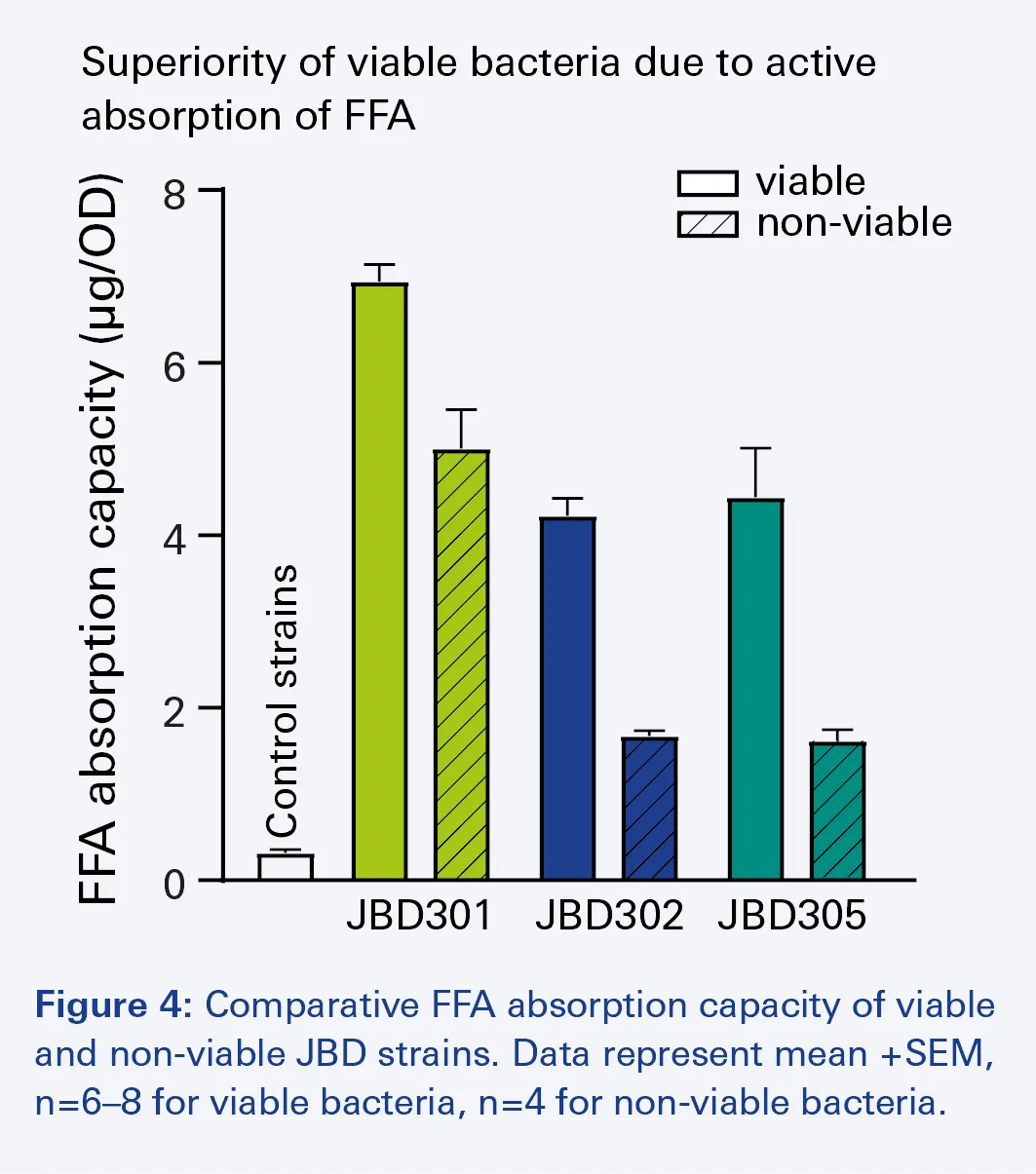
In parallel the experiment was performed using bacteria rendered non-viable through UV radiation or heat treatment (tyndallization), to elucidate whether fatty acid uptake occurs solely through passive surface binding or involves active cellular internalization.
The results demonstrated that although the inactivated strains are able to bind a certain amount of FFA to their surface, their capacity to absorb FFA was substantially reduced compared to their viable counterparts. For JBD301 the capacity was reduced by 30%, in the case of JBD302 and JBD305 it was reduced by approx. 60% (Fig. 4).
These findings indicate that FFA absorption by JBD strains is not merely a passive surface phenomenon but greatly involves active internalization, for which viable cells are crucial.